
Goal Zero runtime calculator for every model
Goal Zero's calculators start here: 6 Yeti models, all sold new in the US, from the 297 Wh Yeti 300 to the 3,994 Wh Yeti PRO 4000, each linked to a runtime calculator built on Goal Zero's published specs. The Yeti PRO 4000 stands apart as the only one that takes expansion batteries (to 20,000 Wh) and accepts up to 3,000 W of solar, while the Yeti 300, Yeti 500, and Yeti 700 stop at 200 W. All but the Yeti 500 list a UPS switchover, and LiFePO4 runs through the whole range.
Goal Zero sells every power station under the Yeti name, from compact units such as the Yeti 300 and Yeti 500 up to the Yeti PRO 4000, and its site advertises a warranty of up to five years depending on the model. The current Yeti 500 and Yeti 1500 are built for outdoor use, with IPX4 water resistance and strong 12 V outputs, including a 405 W high power port on the Yeti 1500.
Both ship with AC charging set to a slower default mode, so the advertised charge times need fast charging switched on. Goal Zero also says its Power App is required for the connected features on both.
- Models
- 6
- Capacity
- 297–3,994 Wh
- LiFePO4
- 6 of 6


Lineup
Goal Zero lineup
Showing 6 of 6 models
| Chemistry | |||||||
|---|---|---|---|---|---|---|---|
| 297 Wh | 350 W | 600 W | 200 W | 13.7 lb (6.2 kg) | LiFePO4 | Not listed by Goal Zero |
 | 499 Wh | 500 W | 1,000 W | 200 W | 16.1 lb (7.3 kg) | LiFePO4 | Not listed by Goal Zero |
 | 677 Wh | 600 W | 1,000 W | 200 W | 20.3 lb (9.2 kg) | LiFePO4 | Not listed by Goal Zero |
| 998 Wh | 2,000 W | 3,600 W | 900 W | 35.3 lb (16 kg) | LiFePO4 | Not listed by Goal Zero |
 | 1,505 Wh | 2,000 W | 3,600 W | 900 W | 52.75 lb (23.93 kg) | LiFePO4 | Not listed by Goal Zero |
| 3,994 Wh | 3,600 W | 7,200 W | 3,000 W | 115.7 lb (52.5 kg) | LiFePO4 | 20,000 Wh |
Product images: official brand websites (Goal Zero).
By job
Which Goal Zero model for which job
Picked by our runtime engine from the lineup above. The rule for each pick is shown, so you can check it or apply it to another brand.
Small trips and camping
Yeti 70020.3 lb (9.2 kg), about 9 h at 50 W
Rule: Lightest model by published weight whose typical estimate runs a 50 W laptop for a full 8 h day.
CPAP for a weekend away
Yeti 1000 (2026)35.3 lb (16 kg), 2.3 nights per charge
Rule: Lightest model by published weight whose typical estimate covers 2 nights of a 34 W CPAP with heated humidifier, 8 h a night on AC.
Home backup for a day
Yeti PRO 40003,994 Wh, 43 h on the kit
Rule: Smallest built-in battery that covers our 24 h outage kit (fridge, router, 3 LED bulbs, 2 phones) and starts the fridge within its surge rating.
Overnight and all day
Goal Zero on a CPAP and a fridge
Typical estimates from each published capacity, for the Goal Zero models sold new in the US. Models without an AC outlet run the CPAP on DC.
CPAP nights per charge
34 W CPAP with heated humidifier, 8 h a night, AC off between nights
The Yeti 300 covers 5 h 29 min of one 8 h night; from the Yeti 500 up, every Yeti gets through at least a night, and the Yeti PRO 4000 lasts 9.2 nights.
| Model | Per charge |
|---|---|
| Yeti 300 | 5 h 29 min of one 8 h night |
| Yeti 500 | 1.1 nights |
| Yeti 700 | 1.5 nights |
| Yeti 1000 (2026) | 2.3 nights |
| Yeti 1500 (2026) | 3.4 nights |
| Yeti PRO 4000 | 9.2 nights |
Fridge hours per charge
Full-size refrigerator, 123 W with the compressor on a third of the time
The Yeti 300 can't start a fridge; the Yeti 1500 (2026) comes closest to a full day at 23 h, and only the Yeti PRO 4000 passes it (2.6 days).
| Model | Per charge |
|---|---|
| Yeti 300 | Won't run: startup surge over its 600 W rating |
| Yeti 500 | 7 h |
| Yeti 700 | 10 h |
| Yeti 1000 (2026) | 15 h |
| Yeti 1500 (2026) | 23 h |
| Yeti PRO 4000 | 2.6 days |
A Goal Zero solar generator, in the usual sense, is a Yeti plus solar panels: the Yeti decides how long your devices run, and its solar input limit, 200 W to 3,000 W here, caps how fast panels can refill it. Solar charging time calculator
Brand facts
Goal Zero at a glance
Chemistry covers every model we track; UPS and expansion cover the models sold new in the US. The warranty, app and company facts were read on Goal Zero's own site on 11 Oct 2026, separately from the intro above, which carries its own check date; anything we could not confirm there is left out.
- Chemistry
- All 6 models we track list LiFePO4 cells.
- UPS
- 5 of 6 models publish a UPS switchover time; the fastest listed is 15 ms.
- Expansion
- 1 of 6 models take extra batteries.
- Warranty
- 5 years on the current Yeti 300, 500, 700, 1000, 1500 and Yeti PRO 4000; 2 years on older NMC Yeti X models. Goal Zero asks owners to charge the battery fully within 7 days of purchase and at least every 6 months to keep coverage.
- App
- The Goal Zero Power App is needed for the connected features on the Yeti 1500.
- Company
- Goal Zero's About page says it is joining forces with BioLite.
Quick picks
Quick pick by need
Computed from published specs. Each card names the model that meets the numbers, not a recommendation.
Highest continuous AC output
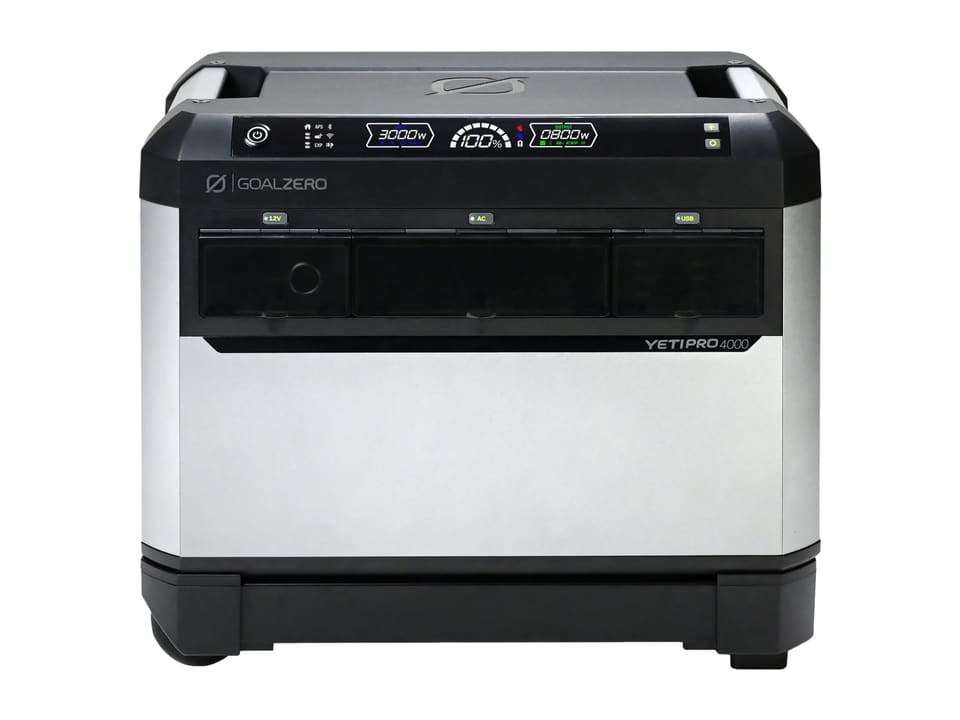
Goal Zero Yeti PRO 4000
3,600 W
Published continuous AC rating, not surge or boost.
Guides