






52 models tracked, 49 sold new in the US · 6 brands · every spec linked to its source
Power station runtime calculator: how long will it run?
Free, no sign-up. Pick a station and what you plug in. You get the runtime, a can-it-run verdict and the math behind it.
The calculator above estimates how long a portable power station will run the things you plug into it, and whether it can start them at all.
It is built for two kinds of reader: someone comparing models before buying one, and an owner who wants to know if a kettle, microwave or space heater will trip the station they already have.
Choose a station by name, add devices from the list or enter your own wattage, and set how long it has to last. The answer comes as a cautious, typical and optimistic runtime, with each assumption labelled.
Worked example
A microwave that pulls 1,500 W from the outlet is a common first test. The EcoFlow RIVER 3 Plus can't run it: its inverter is rated 600 W continuous, so it shuts off. The Anker SOLIX C1000 accepts it, but at 83% of its 1,800 W continuous rating the calculator flags a tight fit, a hint to keep other heavy loads unplugged while it heats.
Kilohour is independent of, and not endorsed by, these brands. Logos identify the brands we cover. Image credits
Model calculators
Popular power stations


Product images: official brand websites (EcoFlow, Jackery, BLUETTI, Anker SOLIX, Goal Zero, DJI).
Guides and planners
Plan for a situation
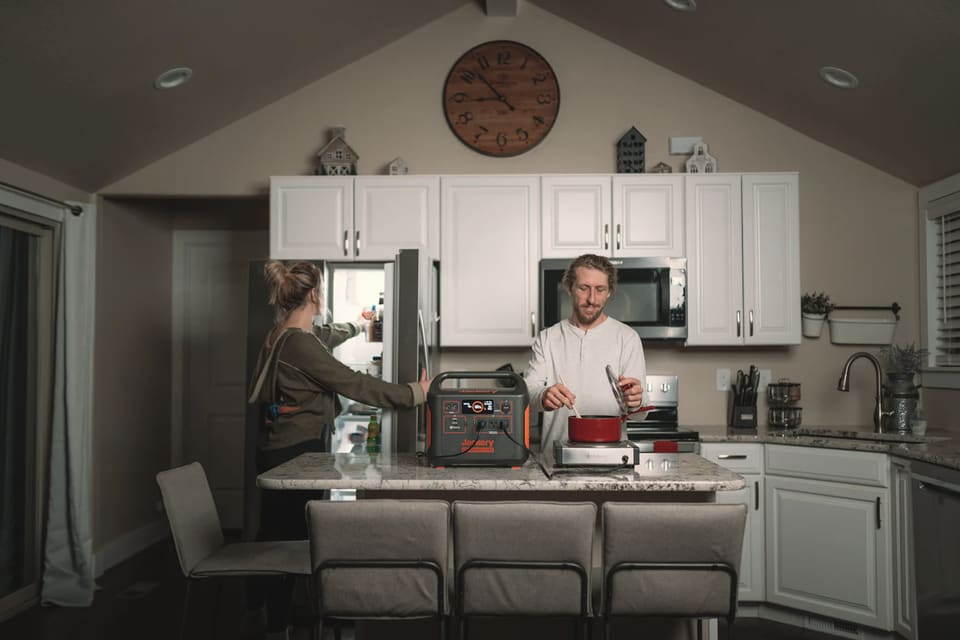
Photo: Jackery Power Station on Unsplash 48 h outage planHome outage
Keep the router and a laptop going through a two-day outage, at about 30 W on average.

Photo: Jackery Power Station on Unsplash Hours to refillSolar recharge
How long a panel takes to refill a station, clipped to its solar input limit.
- Nights per charge
8 hours a night
CPAP overnight
How many nights a station runs one machine, with and without the inverter on.
- Wh you need
What size do I need?
Add your devices and days without power. See the capacity it takes and which models meet it.


Methodology
How the numbers are made
Sourced specs in, labelled defaults only where a maker is silent. Nothing is filled in by guesswork.
Read the methodology- 1
Rated capacity
The Wh the maker publishes, linked to its spec page and dated.
- 2
Usable energy
Cut to what the battery can deliver: 90% by default when unpublished.
- 3
Real draw
Your devices plus inverter loss (88% efficient) and 10 W idle draw.
- 4
Runtime range
Cautious, typical and optimistic hours, rounded down, never up.